ENGLISH WALL TEXTS
Introduction
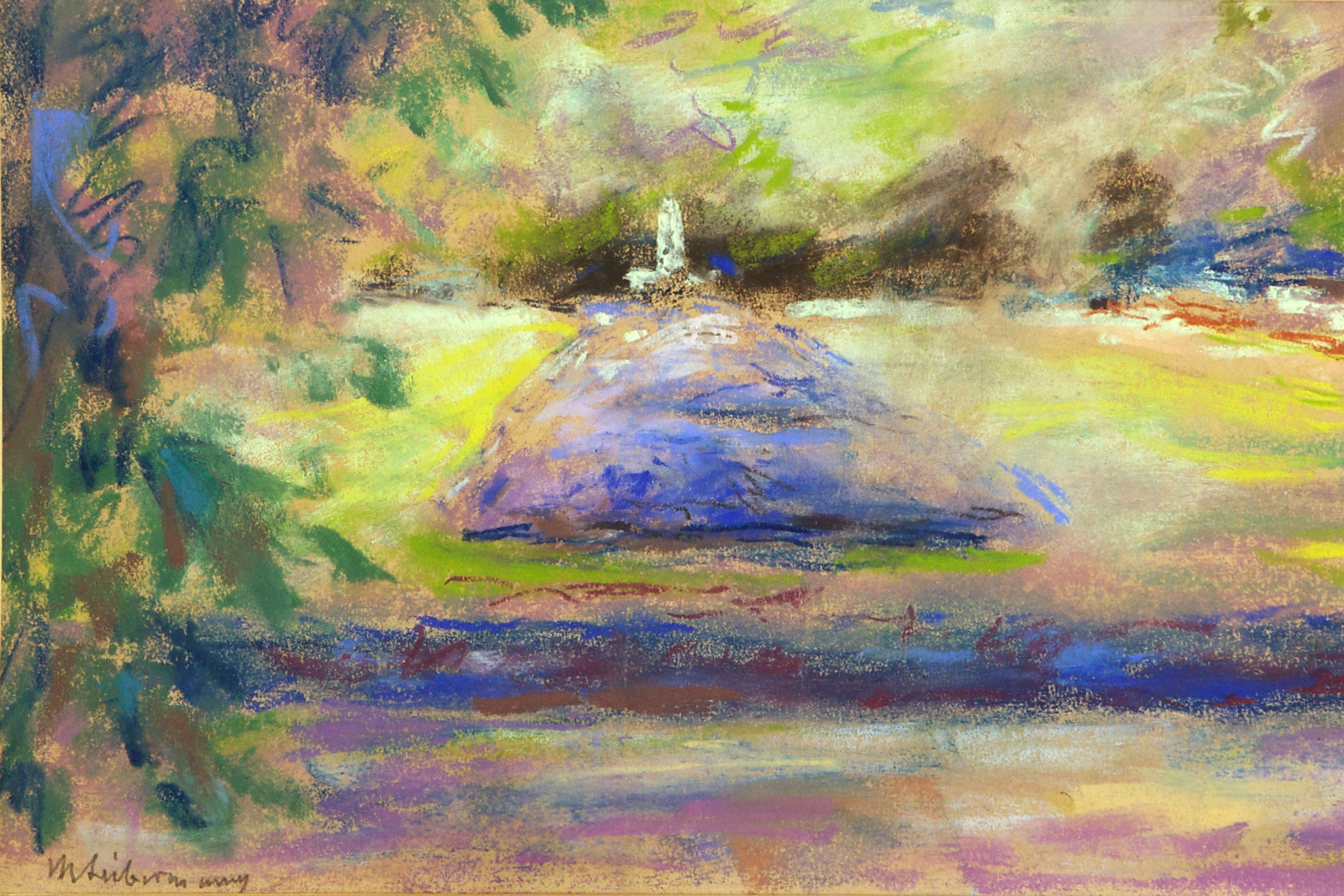
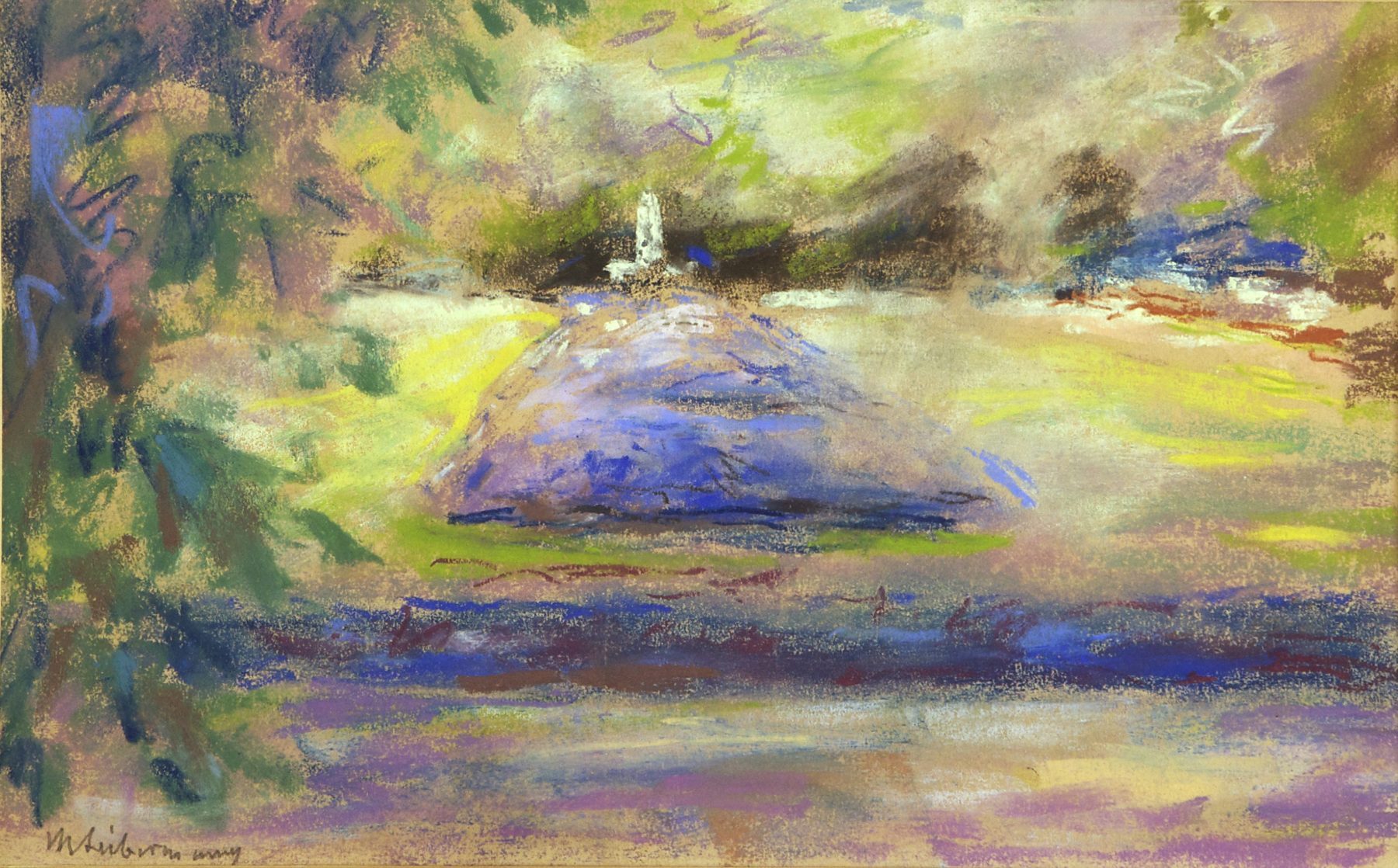
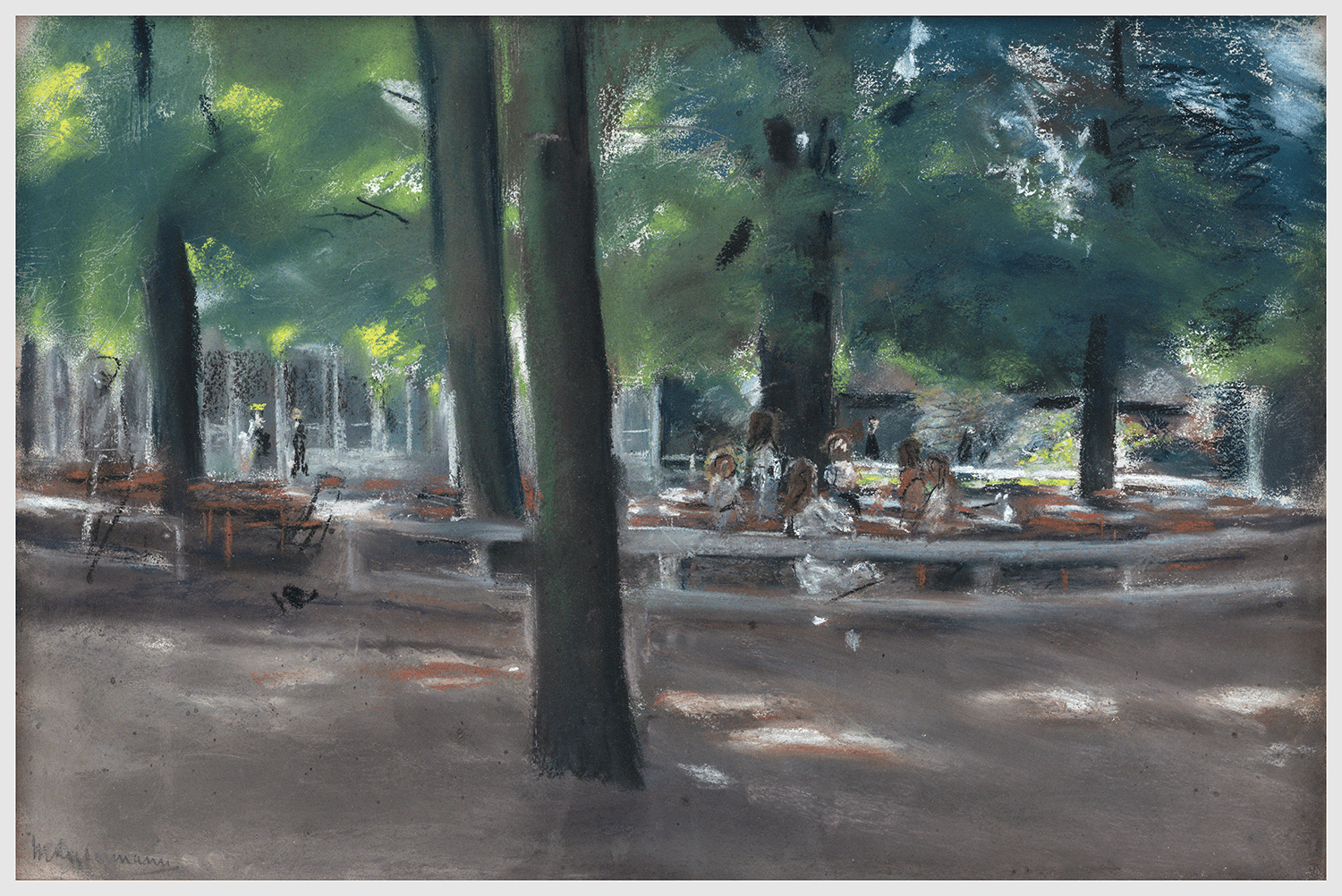
The art of drawing accompanied Max Liebermann (1847 – 1935) throughout his entire artistic career. His artistic development can be vividly retraced through his pastels. Here in the first exhibition room, alongside Tiergarten scenes and avenues, you are welcomed by sketches on autograph letters that symbolically capture the fleeting moment which he, in that very situation, deemed worthy of being pictured. With this exhibition we invite you to train your eye for the materiality, form, luminosity and contrasts of this so far little-researched technique.
In the late 1880s, Liebermann turned to the pastel technique for the first time. After initial works in pencil, pen and ink, as well as the transition to black chalk, he developed his draftsmanship further into coloured chalk. Over the years, initially as copies and repetitions of his well-known motifs, his works increasingly took on a sketch-like character. Rubbed with the heel of the hand and with the fingers, Liebermann created unique worlds of colour. Turning away from naturalistic painting, he pursued instead an impressionist conception of art. His spontaneous sketches thereby became independent works and, over time, developed an ever more abstract effect.
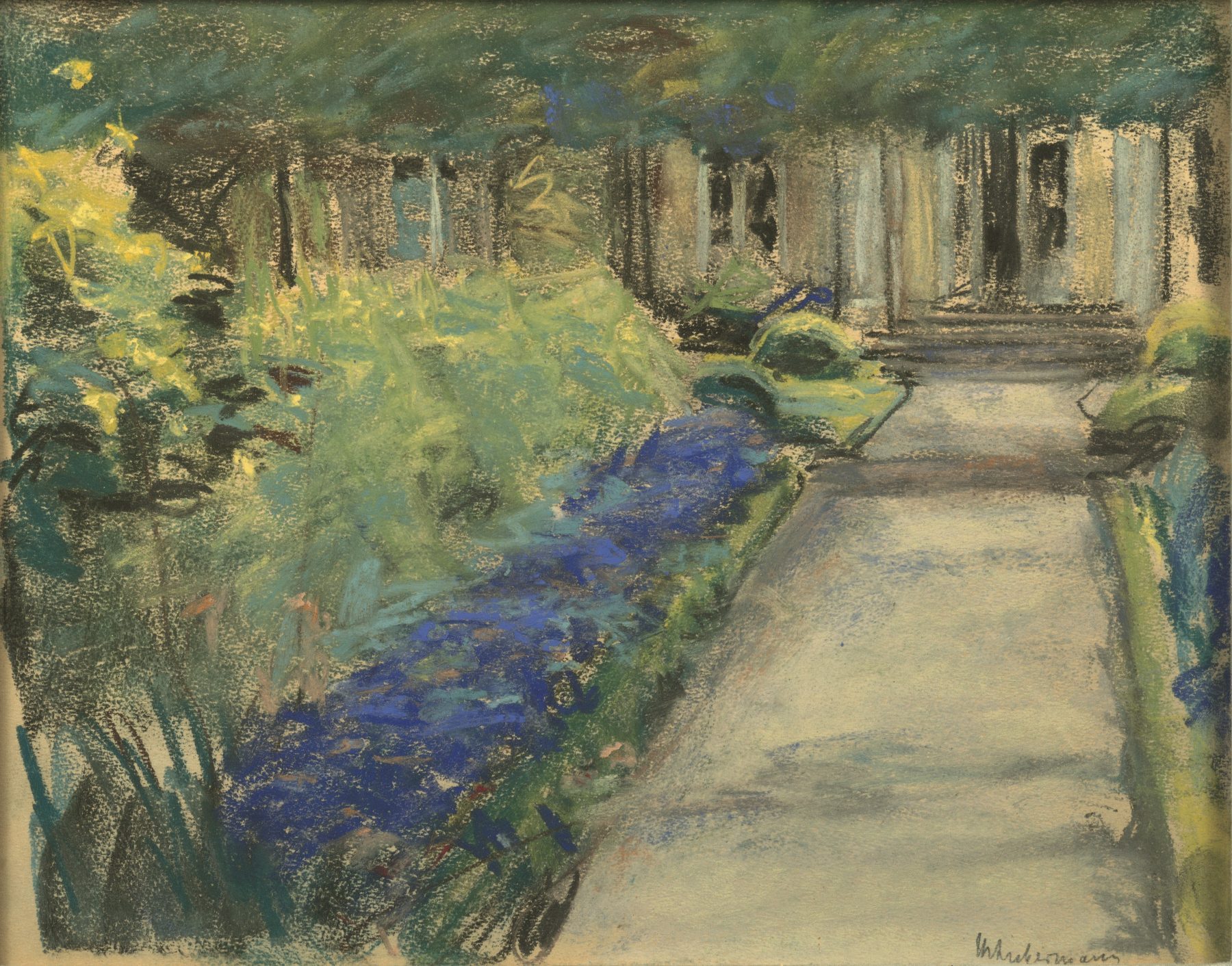
The term pastel derives from the Italian “pasta”, or “pastello”, and can be translated as “paste of pressed coloured dust”. The pastel found its beginnings in the Renaissance and experienced a prime in the French and Italian Rococo. The popular binder “gum arabic” bonds the dry colour pigments together and thereby enables a particular pictorial effect. Frequently, hand-made natural papers with a rough surface, developed especially for this technique, are used. The embossed line of sketchbooks is often visible at the edge of the sheet. If pastels are further worked over with water-soluble opaque paint, they become gouache, as here in the pastel Colomierstraße in Wannsee.
As early as 1890, Liebermann’s pastels entered the first museums, foremost among them the Hamburger Kunsthalle. Its director Alfred Lichtwark was aware from early on of the particular value and appeal of these works, and he placed them on a par with oil painting. The art dealer Hermann Pächter likewise soon commissioned Liebermann to reproduce his most important pictorial motifs – such as the Netzflickerinnen (Net Menders), the Kirchgang in Laren (Churchgoing in Laren) and the Altmännerhaus (Old Men’s Home) – in pastel. Liebermann soon exhibited his pastels as independent works of art at the Berlin Secession, and yet it was not until 1927 that an exhibition devoted solely to pastels was realised.
The French Model Edgar Degas
The art of the French modernist Edgar Degas (1834 – 1917) impressed Max Liebermann. As early as the beginning of the 1870s, Degas engaged with drawing in pastel. Over the years he developed an individual style for which he received universal admiration. Degas became known for his ballet and opera scenes from Paris: with his view from the box onto the stage of the Berlin Staatsoper Unter den Linden, Liebermann imitated his French colleague and took up his pictorial tradition. Today Degas is viewed critically – on the one hand because of his pictorial depictions of underage girls, and on the other hand on account of his antisemitic stance. Liebermann was aware of Degas’s position; nevertheless, he valued his artistic worth and collected his works from 1892 onwards. The appreciation was mutual, for at that time Degas himself owned a preparatory drawing by Liebermann for the work Der zwölfjährige Jesus im Tempel (The Twelve-Year-Old Jesus in the Temple). After Liebermann visited Edgar Degas in Paris, he wrote to his friend Alfred Lichtwark: “[Degas] received [me] with words of the highest praise for the Jesus and said that the drawing had inspired him to look out for my works everywhere.” When the art dealers Paul and Bruno Cassirer in Berlin presented Liebermann’s works with Degas, Liebermann acquired a further work, a painting by the Frenchman.
Text in Showcase 1
Which pastel chalks Liebermann used is unknown. What is known is that the collector and textile merchant Siegbert Marzynski gave him pastel chalks from Paris as a gift. Here, by way of example, we show a pastel box from the French firm Sennelier. Sennelier’s shop, founded in 1887, has been located on the Quai Voltaire in Paris ever since. Well-known artists such as Cézanne and Picasso frequented the premises. In 1904, alongside oil paints and watercolours, they added pastel chalks to their range.
Liebermann’s pastels found their buyers. The art dealer and publisher Bruno Cassirer dedicated to Liebermann, on the occasion of his 80th birthday in July 1927, a comprehensive exhibition featuring 80 pastels. Liebermann’s biographer Karl Scheffler wrote the foreword to the accompanying catalogue. On view were above all motifs from the artist’s travels to Holland, to Florence, Rome and Hamburg. Most of the works exhibited came from the artist’s own possession. Only a few works were contributed by other collectors, among them Bruno Cassirer, the historian Eduard Fuchs, Liebermann’s daughter Käthe Riezler, the entrepreneur Hugo Cassirer, and the educator Toni Lessing. The show was part of a major birthday celebration in Berlin, about which Liebermann commented rather reservedly: “It will be dreadful in Berlin: the true exhibition epidemic: the 100 pictures at the Academy, pastels at Bruno Cassirer’s (hopefully not quite so many), several hundred drawings at Paul Cassirer’s!” It is a great pleasure that today we are able once again to present in the Liebermann-Villa individual pastels from that earlier exhibition.
Text in Showcase 2
In 1898, Liebermann composed, for the journal PAN, an initial essay in art writing on Edgar Degas. Shown here is the eighth edition of the essay, which appeared at Bruno Cassirer’s publishing house in 1922 with additional illustrations and supplements. In it, Liebermann repeatedly described his colleague as a genius: “[…] Degas [has] become a factor with whom every modern painter, consciously or unconsciously, must come to terms: he can no longer ignore him.”
Above all in Liebermann’s landscape pastels and seascapes, clear references to the work of the French impressionist are manifest. The pastel by Degas reproduced here on the right-hand side of the showcase, in the catalogue Degas. un peintre impressionniste? (Degas. An Impressionist Painter?) from the year 2015, appears exemplary for Liebermann. The individual figures on the beach are indicated by mere strokes, and both pastels capture a windy and overcast mood. Both artists are united by the observation Liebermann formulated in 1898: “It is a purely sensuous art, which is not to be understood but only to be felt.”
Summers on the Coast
For more than 40 years Max Liebermann travelled to Holland, the first time in 1871. In what he himself declared his „painterly homeland,” he found inspiration far from the metropolis. It was in Holland that he developed his personal artistic signature. He devoted himself to the canals and avenues, fishing villages, the wide dune landscape, garden taverns, and the joyful bustle of the weekly markets. Influenced by Rembrandt van Rijn, Frans Hals, Jan Veth, and the painters of the Hague School, above all Jozef Israëls, Liebermann trained his eye. Amsterdam, Laren, Haarlem, Zandvoort, Scheveningen, Dordrecht, Noordwijk, and Katwijk were the most important way stations for the German painter.
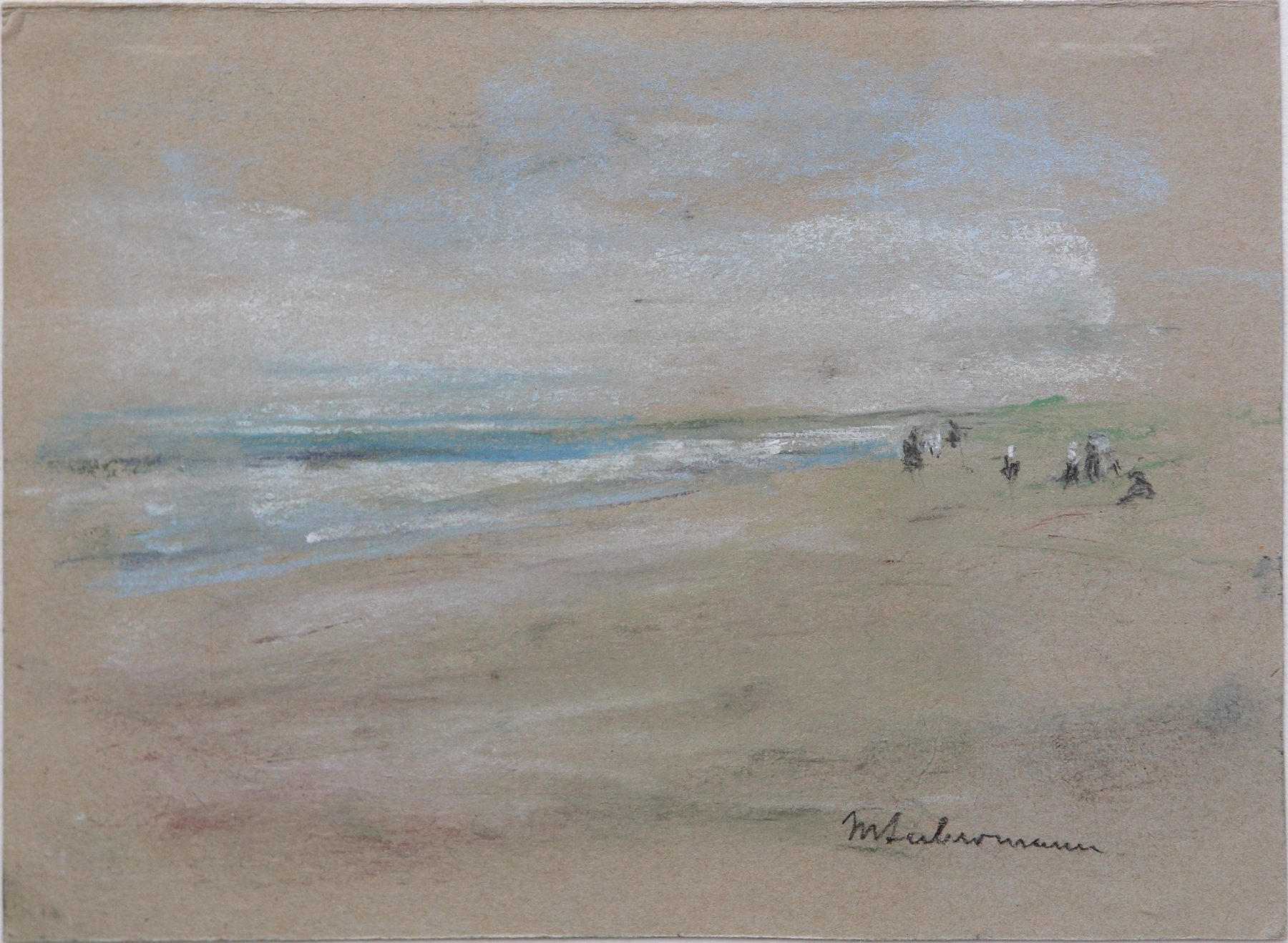
In the coastal town of Noordwijk Liebermann had quickly made a name for himself, so much so that one summer the journalist Harry David even accompanied him there. The latter recalled the occasion in 1912 in the Berliner Tageblatt: “On one cold, rainy afternoon [Max Liebermann] climbed into a bathing-cart, drew out his sketchbook and pastel box, and in this far-from-comfortable studio created some of his enchanting little pastel sketches: greenish sea with a rain-grey sky and the fine, so very lively figures in the background. Quite peculiar is the use of the soft, broad-stroked pastel material for sketches of so small a format. The result, however, is not only softness but at times a depth and fullness of tone that is hardly surpassed by oil paint. And it is positively astonishing that on such little sheets, with this dry chalk dust, he is also able to render bright sunlight. Surely this technique must spring from the hazy atmosphere of Holland.“
Here we can only agree with the journalist: Liebermann drew incessantly on the beach, in the shimmering midday heat as well as in stormy weather, the deserted strip of coastline. Drawing the tone of the paper itself into the picture, Liebermann achieved the most varied of pictorial effects. The handy format and the practicality of the medium may also have been fundamental to the striking abundance of his coastal pastels. They may well have appeared freer and less laboured than many of the oil paintings worked out in his studio down to the smallest detail.
Everyday Life as Motif
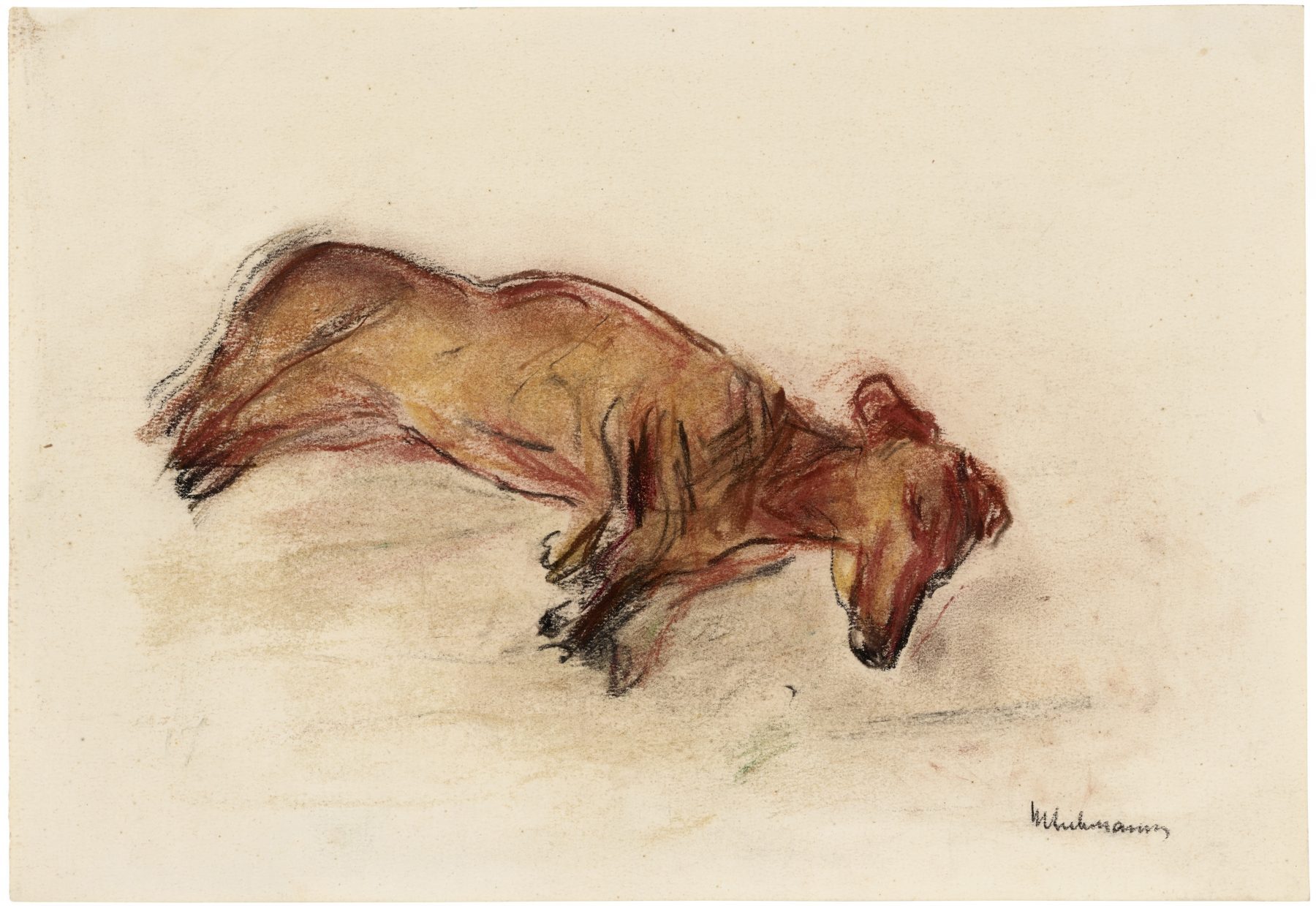
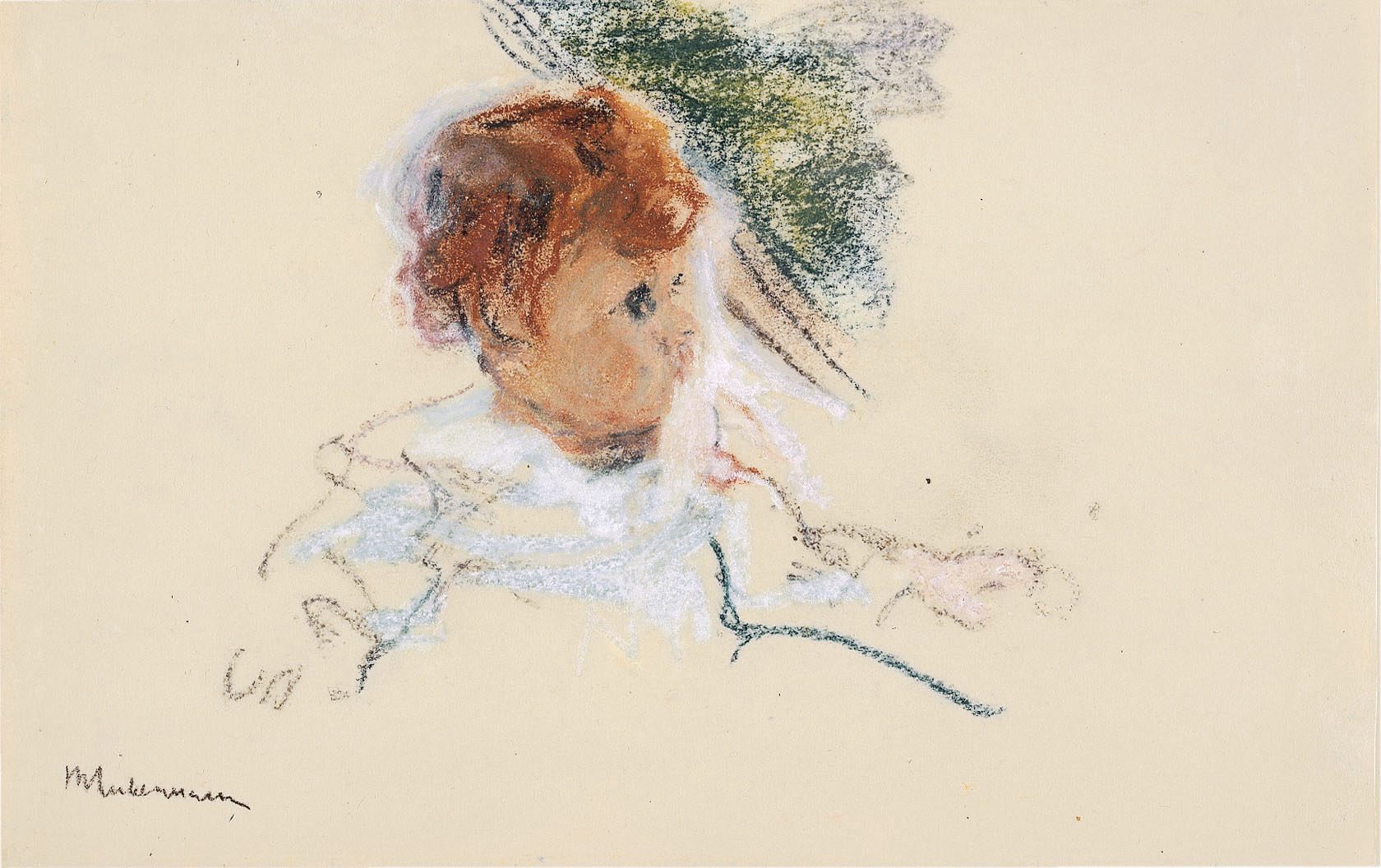
Liebermann also drew his wife Martha and his daughter Käthe in pastel. These expressive snapshots captivate through their intimacy; they offer valuable glimpses into the family’s daily life. In 1917 his granddaughter Maria was born; she is shown here as a small child. Through Liebermann’s pictures we watch her grow up. The family dachshund, too, became a beloved motif. The Liebermanns are known to have lived with three dachshunds in all, named Männe, Michel, and Nicki. Visitors to the house were initially eyed critically by the animals. The journalist Géza von Cziffra remembered in this context that the artist is said to have once remarked: “If my dog is being so friendly to you, then I suppose I shall have to be friendly too and tell you something.“
For his early pastels Liebermann chose dark, almost „quiet“ colours. As early as the late summer of 1893 a series of pastel portraits came into being: the two brothers Edouard and Hans Grisebach, Marie Bode (daughter of the Gemäldegalerie director Wilhelm Bode), and the physician and pathologist Rudolf Virchow. Photographs of the sitters also served Liebermann as models, both in the case of Virchow and in the rather static-looking portrait of his cousin Antonie Liebermann. She had been drawn posthumously at the request of her daughter. Liebermann gained recognition for his portrait pastels as early as 1895, when at the “International Exhibition” in Venice he was awarded First Prize for his portrait of the young poet Gerhart Hauptmann.
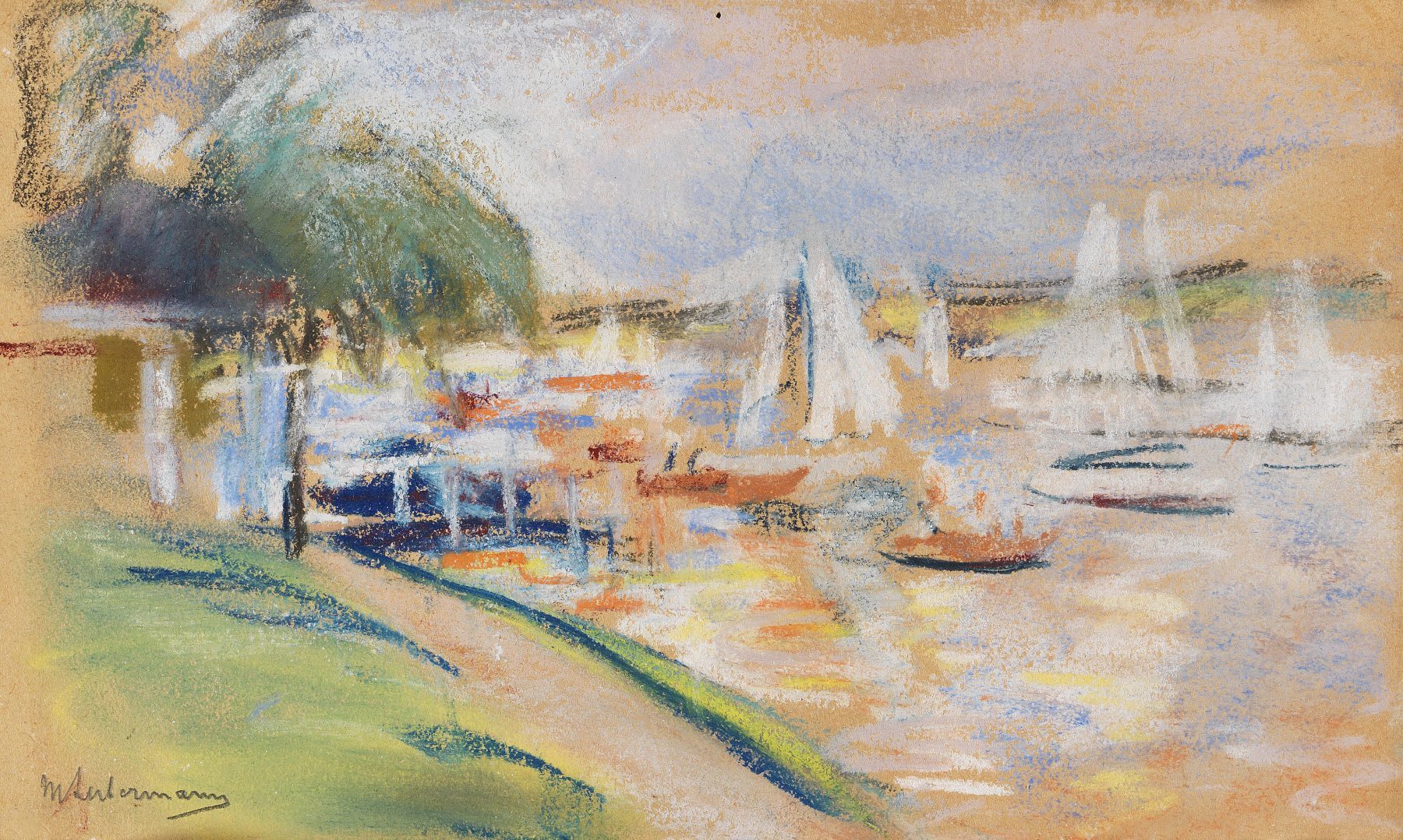
Liebermann continued to devote himself steadily to his immediate surroundings, creating spontaneous studies of nature in his garden at Wannsee, where he observed, among other things, the cheerful goings-on out on the water. Here he carries the sketch-like and study-like quality of his work to its high point. For the summer colourfulness he made use of the painterly components of the pastel technique.
A Walk Through the Artist’s Garden
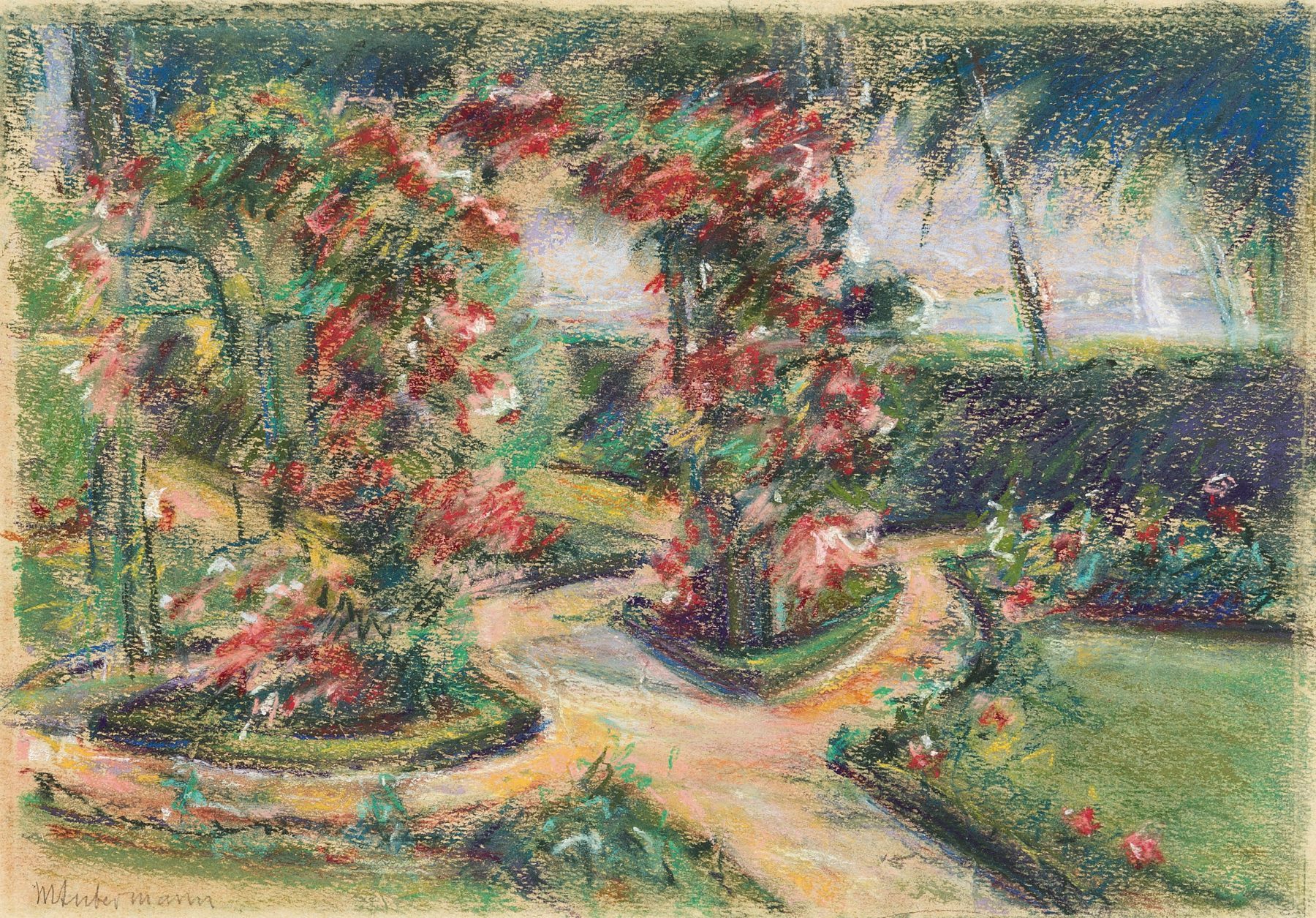
His late motifs are characterised by a dissolution into magnificent worlds of colour through strong contrasts. The Liebermanns spent the months from April to October at their summer house on the Wannsee. From his vividly coloured pastels the seasons and the unfolding splendour of the blossoms reveal themselves. The carefully planned garden provides the structure, yet what mostly dominates these views is the lush abundance of bloom. The garden paths serve to delimit a nature that is positively overflowing. In the kitchen garden Liebermann turned his attention to the perennials, fruit trees, and vegetable beds, as well as to the striking bean trellis. In the beds Liebermann had vibrantly coloured varieties planted, such as yellow goldenrod, blue summer sage, snapdragons, yellow, orange, and red coreopsis (“tickseed“), and yellow giant coneflowers. Liebermann obtained his vividly coloured perennials from neighbouring nurseries, when his own gardener was not raising the varieties himself.
The flower terrace in the lakeside garden appears in the pastels both in its spring planting of violet and yellow pansies and in its summer planting decorated with red pelargoniums, framed by neatly clipped bedding edges. Liebermann came to know and appreciate the red-and-green contrast through the French artists.
The view onto the hedge gardens was likewise captured by Liebermann in chalk: The hornbeam hedge appears here almost as a green wall amid dense foliage.