Off to new works! Max Slevogt, Bruno Cassirer and Max Liebermann
In our audio guide to Exhibition „Off to new works! Max Slevogt, Bruno Cassirer and Max Liebermann,” you will discover more about the extraordinary collaboration between the illustrator Max Slevogt and his publisher Bruno Cassirer.
For the best listening experience, we recommend using headphones.
WELCOME
Individual audio stations are waiting for you in the exhibition. This time everything is designed a little differently. Let yourselves be surprised! Just scan the QR codes on the object labels and wall texts.
But first of all, we hope you enjoy listening!
Self-Image/Image Seen by Others
Speaker I:
Oh, who is this here in the display case?
Speaker II:
That is Max Slevogt. It’s an etching. It shows him at the age of fifty-two.
Speaker I:
Phew, Slevogt looks a bit marked by life there, doesn’t he? The print really does have something genuinely somber and ominous about it.
A Business Friendship
Speaker II:
Oh, that’s something I wanted to tell you too. The exhibition also tells of the friendship and the business relationship between Max Slevogt and Bruno Cassirer.
Speaker I:
What sort of people were they? How should one actually picture the two of them? What were they like?
Speaker II:
Max Slevogt was certainly regarded as a life-loving, impulsive bon vivant. I also have the impression that he made real fun out of life and had a sense of humor. In his letters, for instance, he addressed Cassirer as “Most Serene and Most Mighty One.”
A Visit to Bruno Cassirer at the Publishing House
Speaker I:
I would so love to have visited Bruno Cassirer sometime. It must have been pretty exciting at his publishing house.
Speaker II:
Yes, there really must have been a quite exceptional, bustling atmosphere there. Karl Scheffler, the editor-in-chief of the journal “Kunst und Künstler”, later described the mood at the publishing house rather beautifully, saying something like: “During a conference with [Bruno Cassirer] on questions of art and literature, the telephone rang incessantly. He spoke with people from the sports press, with his trainer and his driver, bought hay and oats, and named his racehorses [Fidelion, Morgenwind, and Paprika] with the same assurance with which he had just been pronouncing the names of modern artists.”
Ali Baba
Speaker I:
Oh wow, some of the scenes here in this room really are depicted with surprising explicitness and cruelty. I wouldn’t have thought that was normal for the period.
Speaker II:
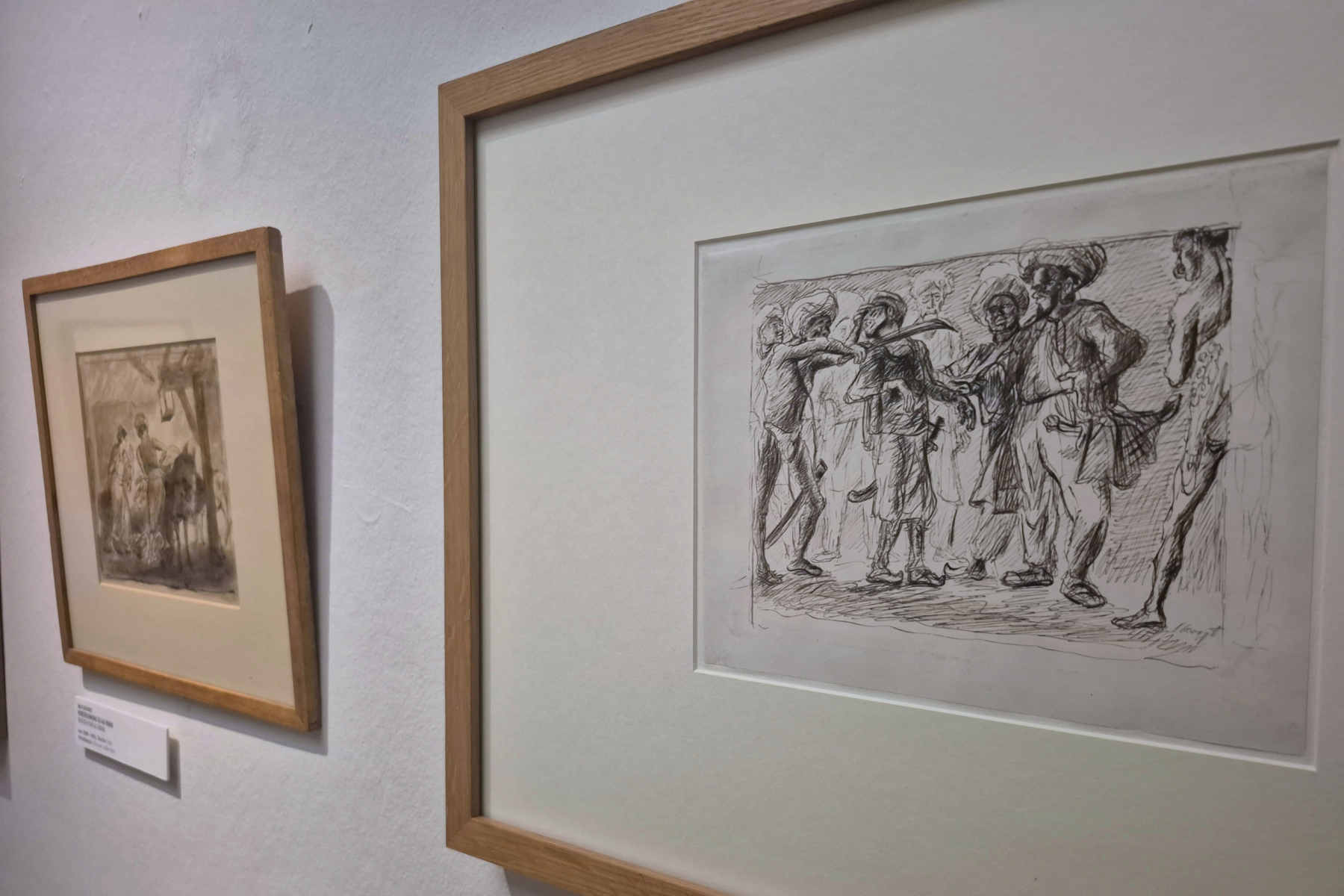
Yes, from today’s point of view the fairy tale “Ali Baba and the Forty Thieves” strikes us above all as brutal. Slevogt was deeply fascinated by it and chose particularly gruesome scenes to draw.
The Faust II Portfolio
Speaker I:
And who actually collected all those deluxe volumes from the Cassirer publishing house?
Speaker II:
Among the upper middle class, it was considered good form to collect publications from Bruno Cassirer’s publishing house. Cassirer said that the Faust II illustration project was his publishing house’s great pride. Here on the round table, you can see how large these portfolios and deluxe editions were. The Landesmuseum Mainz has produced a portfolio here after the original. It is exactly the same size as the originals. Feel free to leaf through it.
King Thrushbeard
Would you like to dive deeper into the fairy-tale world of the Brothers Grimm? Then do listen on here.

King Thrushbeard
The Blue Light
Do you actually know the fairy tale “The Blue Light”? No? Well then, it’s high time…
The Blue Light
English Wall Texts
On to New Works! Max Slevogt, Bruno Cassirer, and Max Liebermann
HALL
What would a brilliant idea be without a strong network, without people who carry it through to the end? The publisher Bruno Cassirer (1872–1941) and the artist Max Slevogt (1868–1932) stand as the very emblem of such a successful collaboration. They were united by a delight in artistic experiment and an incomparable spirit of innovation.
The exhibition tells how the gifted illustrator Max Slevogt and the respected publisher and art dealer Bruno Cassirer found their way to each other, which ideas they shared, and how major works of book illustration grew out of them. It has been developed in cooperation with the Landesmuseum Mainz and the Saarlandmuseum Saarbrücken. And it is not only these two personalities who meet here – Max Liebermann (1847–1935) also enters into dialogue with them as a companion and a decisive protagonist of the age.
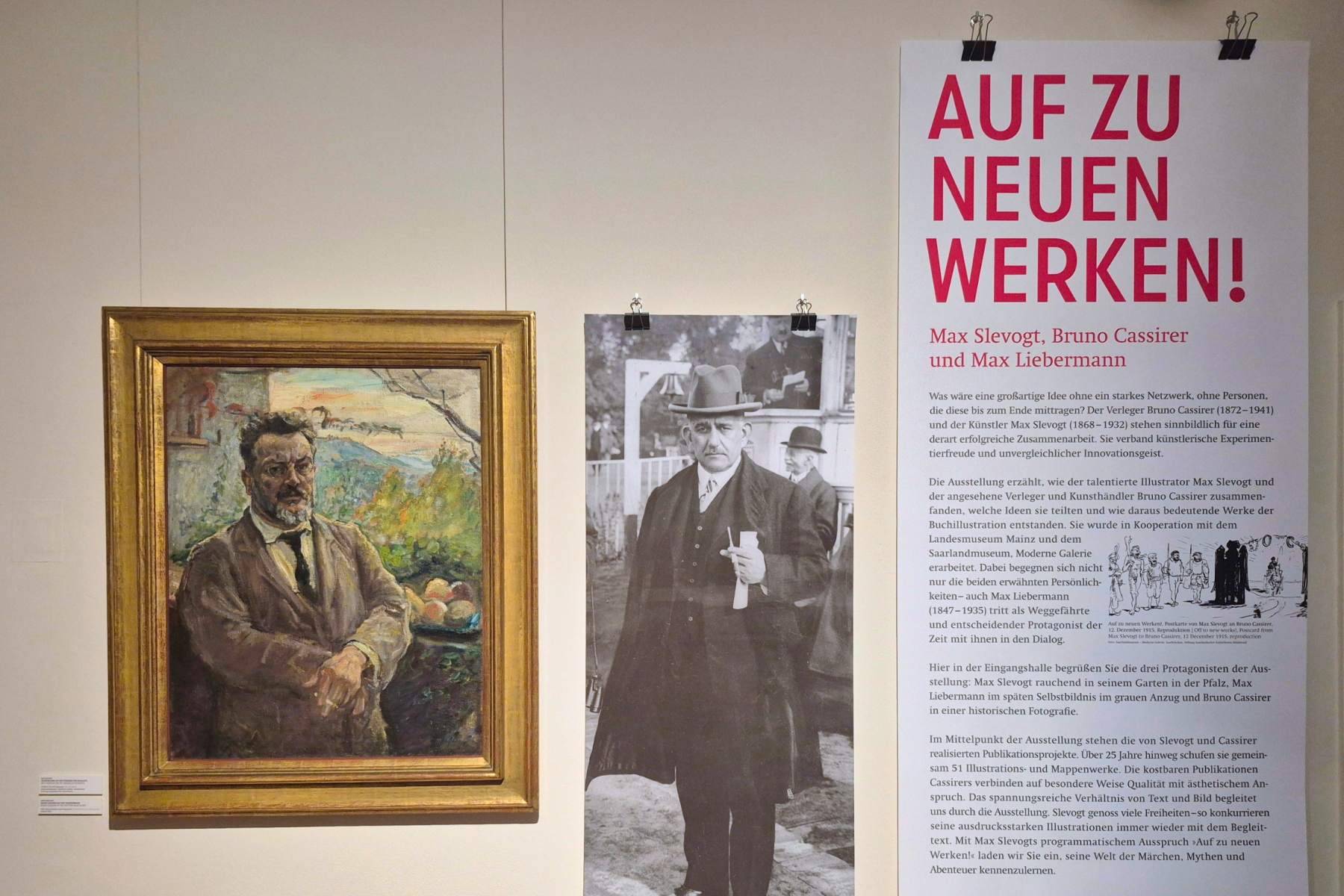
Here in the entrance hall you are greeted by the exhibition’s three protagonists: Max Slevogt smoking in his garden in the Palatinate, Max Liebermann in a late self-portrait in a gray suit, and Bruno Cassirer in a historical photograph.
At the heart of the exhibition are the publication projects that Slevogt and Cassirer brought to fruition. Over more than twenty-five years they jointly created fifty-one illustrated books and portfolio works. Cassirer’s precious publications combine quality with aesthetic ambition in a very particular way. The charged relationship between text and image accompanies us throughout the exhibition. Slevogt enjoyed a great deal of freedom – and so his powerfully expressive illustrations repeatedly compete with the text beside them. With Max Slevogt’s programmatic exclamation “On to new works!” we invite you to get to know his world of fairy tales, myths, and adventures.
LARGER OBJECT LABEL 1:
Menu Card for the 80th Birthday of Max Liebermann
Max Slevogt, 1927, lithograph on handmade laid paper, signed for Martha Liebermann, the artist’s wife
Donation 2021, Wolfgang Immenhausen, Berlin
The menu card designed by Max Slevogt recalls a gala banquet held by the Prussian Academy of Arts in honor of Liebermann’s eightieth birthday. The ceremonial dinner took place in the Swedish Pavilion on the Wannsee on 30 June 1927 – twenty days before Max Liebermann’s actual birthday, since on account of his advanced age he wanted to celebrate the day itself in the quiet circle of his family.
The illustrated menu card tells us the sequence of courses. After an oxtail soup and an Ostend turbot with sauce mousseline came saddle of venison with vegetables hunter’s style. Further drawings show a cook docking the tails of three oxen over a cooking pot, a huntsman riding a stag, and a turbot with a little skirt and parasol of mousseline. An “omelette surprise” and cheese pastries brought the meal to a close. Slevogt’s drawings, which at the time would have been classed as humorous, have to be viewed critically today. The “omelette”, for instance, illustrates a violent assault. Possibly what is shown here is the devil, meant to point to the sinfulness of the dessert. Against the background of current debates about sexualized violence in the visual arts, the scene is questioned critically today. Although it presents this important historical document, the Liebermann-Villa am Wannsee wishes to distance itself clearly from this depiction of violence.
Among the surviving copies of the menu card handed out during the banquet, this sheet is an exception: it evidently served as a thank-you card for Martha Liebermann. On the front and back, fifteen guests left their greetings to the artist’s wife. Among the names that can be made out are those of the critic Max Osborn, the cultural official Edwin Redslob, the painters Hermann Sandkuhl, Rudolf Levy, and Ulrich Hübner, and the sculptor Rudolf Belling, along with many others.
Parents’Bedroom
How They Met, and the Bruno Cassirer Publishing House
In 1899 the paths of Bruno Cassirer and Max Slevogt crossed for the first time. Letters from July of that year document that Cassirer sold a painting on behalf of the artist, then thirty-one years old. Slevogt also maintained an important connection with the artist Max Liebermann from early on: Liebermann visited him in Munich and persuaded him to send works to the First Exhibition of the Berlin Secession. Three months after that promising exhibition, Slevogt – who had studied painting at the Academy in Munich – moved to Berlin. At this time Bruno Cassirer, together with his cousin Paul Cassirer, held the office of secretary of the Berlin Secession and kept an eye on its finances. As early as the fall of 1898 the two had founded Bruno & Paul Cassirer, Kunst- und Verlagsanstalt (art dealership and publishing house) in Berlin’s Tiergarten district. They courted young artists deliberately and won them over to working together.
After the business separation of Bruno and Paul Cassirer in 1901, Bruno devoted himself for the time being to publishing alone. His list included works on architecture and on the history of art and culture, as well as artists’ letters and diaries, biographies, and the occasional catalogue raisonné. Since Slevogt soon counted as the publishing house’s most important draftsman, he was granted freedom in matters of design and subject. Bruno Cassirer also held the reproduction rights to Slevogt’s images.
Cassirer’s publishing house at Derfflingerstrasse 15 was distinguished by the highest quality. With his illustrated art books, he opened up a new market at a level previously unknown. Meticulously and carefully, Cassirer selected much of the book production himself – from the right paper to the layout, from the ideal printing technique for the drawings to the clasps on the portfolios of the limited editions. He first tested his customers’ appetite for buying with individual sheets before bringing out complete books.
Art and Artists
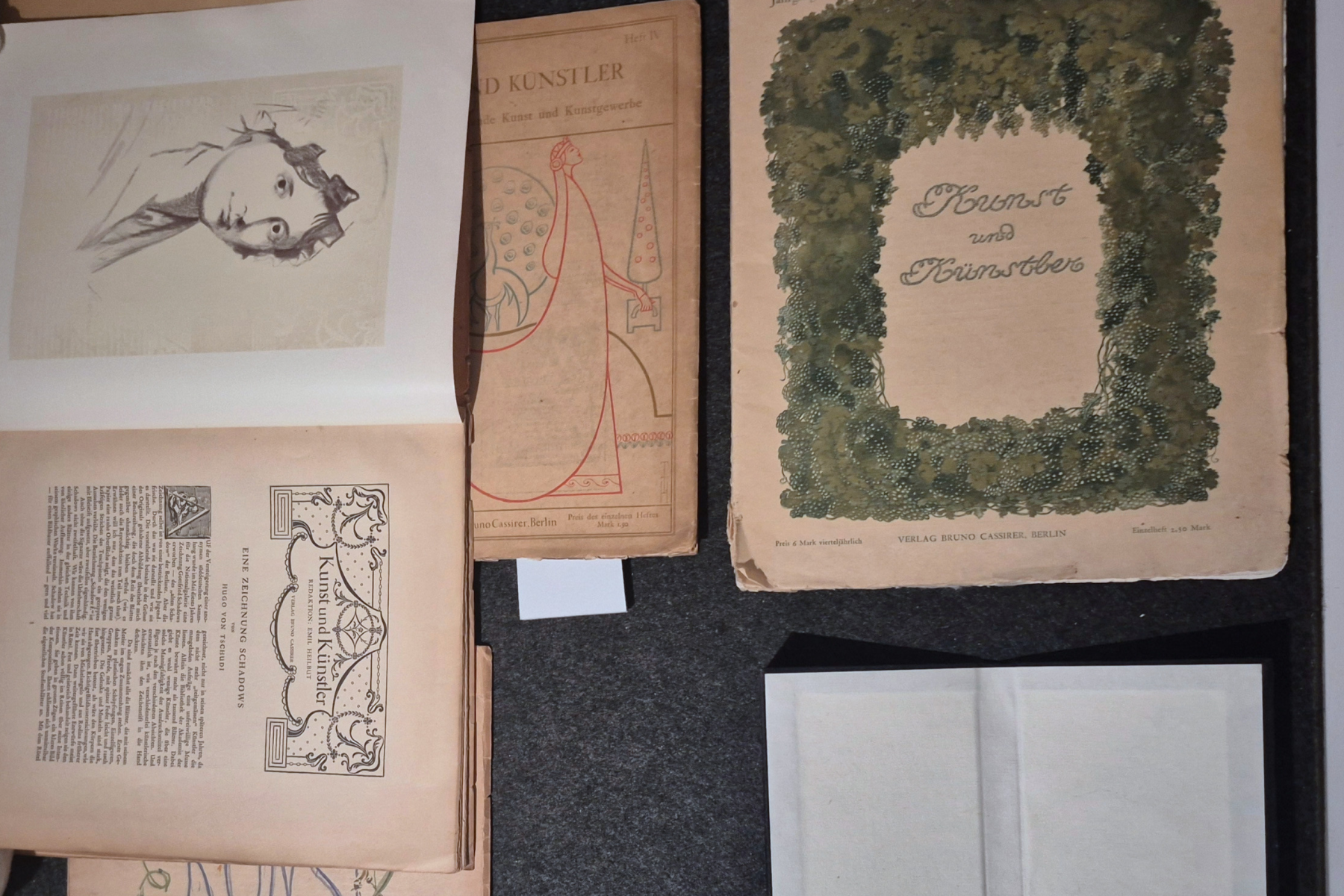
Even as a young publisher, Cassirer already knew how important marketing is. From October 1902 he issued the journal “Kunst und Künstler. Illustrierte Monatsschrift für bildende Kunst und Kunstgewerbe” (Art and Artists: Illustrated Monthly for the Fine and Applied Arts). During the thirty years of its existence, it became one of the leading and most influential art journals in Germany – one that at the same time marketed the Bruno Cassirer Verlag’s own publications. Elegantly designed, the journal appeared monthly in a print run of no more than 3,000 copies and addressed a discerning, art-minded readership. Its target groups were collectors, the art trade, and artists themselves.
“Kunst und Künstler” soon counted as an important vehicle for establishing Impressionist and anti-academic art in Germany – as the mouthpiece, so to speak, of the Berlin Secession. The art of Slevogt and Liebermann was discussed there at length. Their drawings and prints likewise found a prominent place in its issues. To this day “Kunst und Künstler” counts as a valuable source for tracing the canon of the period. From the outset Slevogt drew artful initials and decorative letters in ink and pencil, and created humorous drawings with little monkeys doing gymnastics and with mythical creatures, as shown here. One of the cover designs was judged so successful that it was printed in every issue from at least 1914 until 1931.
Every issue counted as a collector’s item, and the journal is still traded in the art market today. Slevogt himself collected it too; his estate contains volumes 1 through 24 in bound form.
Racing Sketches
From 1899 onward, Bruno Cassirer’s private passion was equestrian sport. In Prussian Berlin the Union-Club had been founded in 1867 and thereafter championed the development of the sport, among other things with the construction of the well-known Hoppegarten racecourse. The popular races quickly became social highlights. The Berliner Traber-Club (Berlin Trotting Club) was founded in 1877; in 1882 a ban on betting followed, which was finally lifted again nine years later and helped racing to a new upswing.
From 1910, Bruno Cassirer found his counterweight to the publishing business in the big city in a stud farm of his own at Damsbrück near Falkensee. He imported and later bred first-class trotting horses from America. With them he achieved a number of successes on the racecourse. In this way he also won over industrialists and merchants from his immediate circle to the sport.
It was Bruno Cassirer who also awakened Max Slevogt’s interest in harness racing and the spectacle that went with it. Horse racing became an important pictorial subject of the period, so that Max Liebermann took it up as well. From 1903 he turned to the polo players in the Jenisch-Park in Hamburg, and from 1908 to the steeplechase in the Cascine in Florence. Suggestions for such motifs also came from France, from the celebrated artists Edgar Degas, Henri de Toulouse-Lautrec, and Édouard Manet.
DISPLAY CASE LABEL 1
Cassirer took Slevogt along to a number of races. Two sketchbooks survive from these visits. The earliest drawings, here in the display case, were made in 1907 at the racecourse in Berlin-Weißensee. In 1923, for example, Slevogt also recorded his fellow artist Emil Orlik in the grandstand at Berlin-Ruhleben.
The motifs were popular. A first signed portfolio titled “Rennskizzen” (Racing Sketches), with six lithographs, appeared in 1915 in an edition of fifty. The two chalk lithographs shown here in this room come from that portfolio: one shows the social bustle at the Ruhleben racecourse, the other studies of the horses in movement. The portfolio “Trabrennen” (Trotting Races) came out only a few years later in a larger edition of 100 copies and was out of print shortly afterward.
LARGER OBJECT LABEL 2, in front of the room:
Disclaimer
The exhibition room shows depictions of violence and death that some age groups may find distressing. Individual drawings contain representations that from today’s perspective are classed as violent, racist, and sexist. The Liebermann-Villa am Wannsee expressly distances itself from any content of this kind. By presenting these works we make problematic aspects of art history visible and open them up to critical examination. We therefore ask our visitors to deal sensitively with material they may find distressing.
Parents’ Dressing Room
From the Thousand and One Nights: Ali Baba and the Forty Thieves
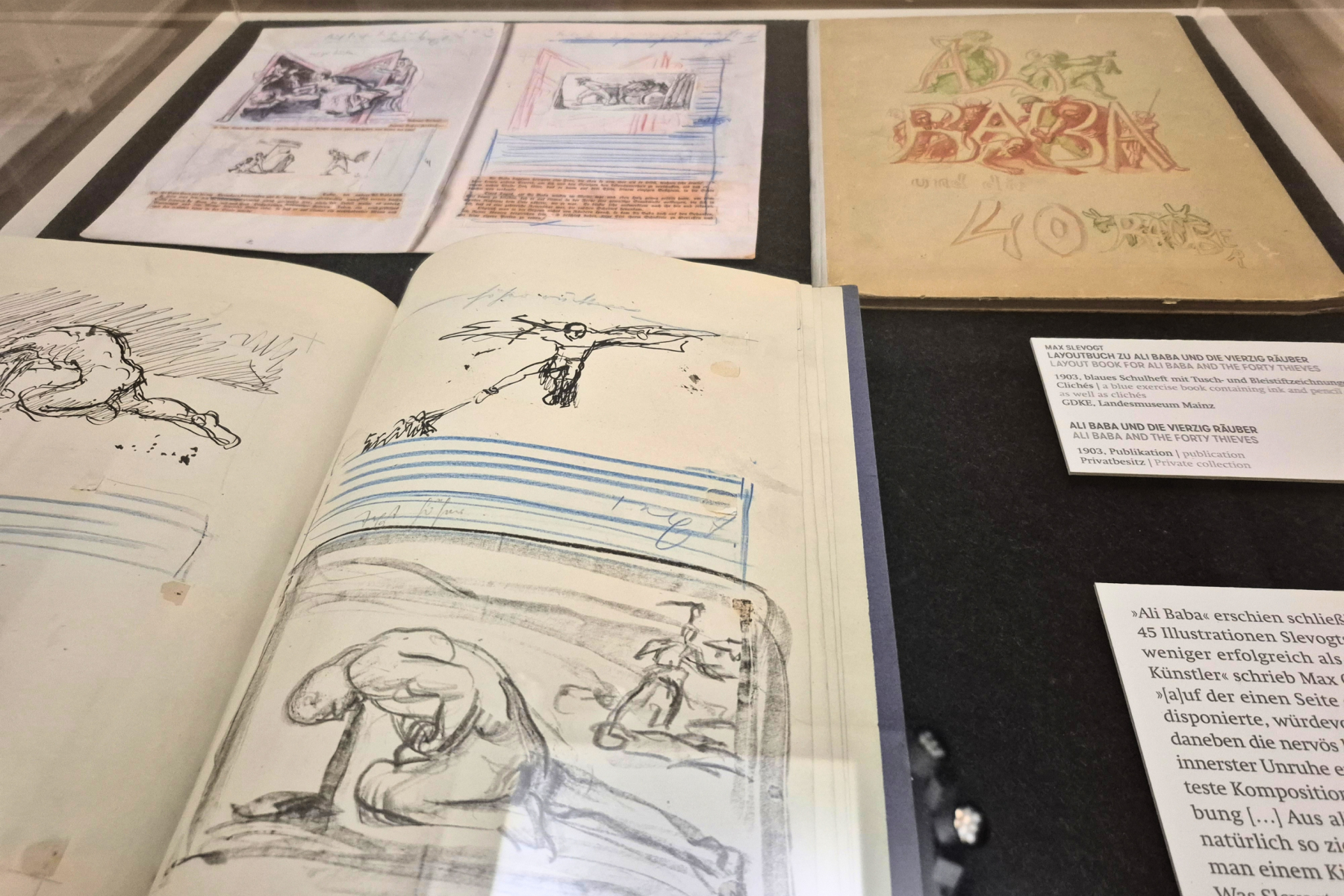
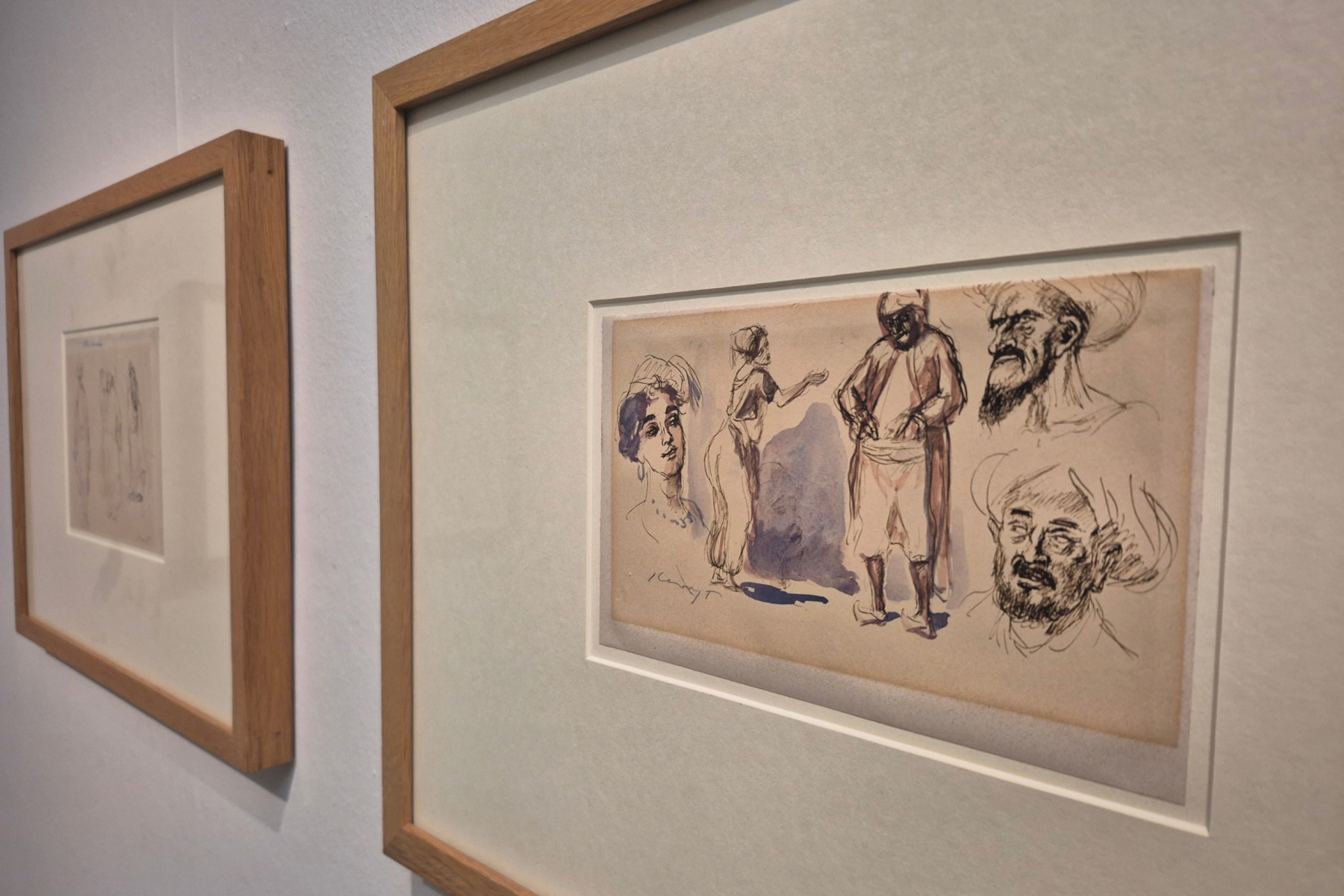
Some 150 drawings were made for the fairy tale shown here, in the years between 1898 and 1903. From this abundance of drawings Cassirer had to make his selection. Among them are a number of violent scenes. Slevogt had chosen only those passages of the text that interested him. He understood the drawings not as illustrations of the text but as free “improvisations”; he would most have liked to publish the pictures alone, but Cassirer refused. A leaning toward the dramatic and toward extreme experience is unmistakable in the artist, and vividly reflects the pulse of the years around 1900.
In this first joint illustration project, Slevogt was able to give his imagination free rein. A good deal is known about their collaboration on it, because the correspondence and the contracts, along with regular statements of account, have survived.
The woodcutter Ali Baba, in mortal danger, lives through hair-raising adventures as the protagonist of the tale. By chance he observes thieves approaching a rock face, their leader calling out the magic words “Open sesame!” – whereupon the entrance to a cave is revealed. Together with the enslaved Morgiana, Ali Baba succeeds in getting at the thieves’ treasure of gold and other valuables. His brother Kasim, by contrast, fails in the attempt, whereupon he is killed by the thieves.
The publication polarized opinion: for some a scandal, for others a masterly spectacle. Some voiced their bafflement that Cassirer could take such a risk as to restage a children’s fairy tale in this manner. Others described the illustrated art book as “[…] one of the most delightful misunderstandings that has ever occurred.”
DISPLAY CASE TEXT 2:
“Ali Baba” finally appeared in 1903 with forty-five illustrations by Slevogt and sold less successfully than had been hoped. In “Kunst und Künstler,” Max Osborn wrote of the publication: “on the one side the well-balanced, clearly ordered, dignified calm of the narrative, and beside it the nervously set down, capricious little pictures, filled with the most inward restlessness. There the most deliberate composition, here the inspiration of the moment […] For all these reasons the book is of course just about the least suitable thing one could put into a child’s hands […] What Slevogt has created with this Ali Baba is the first specimen of a new genre, one that might be called ‘picture books for grown-ups.’”
The layout book on display shows with what meticulousness and what fine craftsmanship text and image were fitted together.
Daughter’s Bedroom
The Buyers
Like Liebermann, Slevogt also made a name for himself as a portraitist. His portraits feel approachable and animated, often in monumental format. Bernhard Dernburg (1865–1937), whom Slevogt portrayed several times, sat in the Reichstag as a founding member and deputy of the left-liberal DDP (Deutsche Demokratische Partei, German Democratic Party). There he acted as a representative of German banking. In April 1919 he was appointed Reich Minister of Finance and Vice-Chancellor, a post he gave up again after only a few months in protest against the Treaty of Versailles. Today Dernburg is regarded as a controversial figure within the colonial administration of the Foreign Office.
As a director of the Darmstädter Bank für Handel und Industrie, Dernburg also collected art by the Secessionists and commissioned paintings. It was precisely this public that took an interest in Cassirer’s deluxe publications. One of them can be found here in this room; we warmly invite you to put on gloves and leaf through the true-to-scale reproduction yourself.
A design for the title page of the almanac – an edition that Slevogt dedicated to his publisher for the firm’s anniversary in 1920 – offers a view down into a deep well from which water is being hauled up with effort. The illustration might stand as an emblem of the labors of many decades of publishing work. With the almanac Cassirer could look back on a considerable success story; among other things, thirty-eight pages listed the books and graphic works that had appeared.
Wartime
Embedded in the context of their own time, the art of Slevogt and Liebermann becomes easier to understand. The accounts that follow also show the field of tension in which some of the book illustrations for Bruno Cassirer came into being. At the outbreak of the First World War, the forty-five-year-old Max Slevogt, the father of two children, had just acquired a country estate at Neukastel in the Palatinate. Even so, he sought to be posted as a war artist on the Western Front. He stayed there for three weeks and recorded harrowing scenes. Bruno Cassirer later published Slevogt’s “Kriegstagebuch” (War Diary) in 1917. Liebermann, on the other hand, almost seventy years old, chose to support the war from Berlin. He supplied drawings for “Kriegszeit. Künstlerflugblätter” (Wartime: Artists’ Broadsheets), which appeared with the competition, at Paul Cassirer’s publishing house. A great many artists did the same, among them Max Slevogt and Käthe Kollwitz. Altogether twenty-seven lithographs by Liebermann appeared in “Kriegszeit.”
Bruno Cassirer did not volunteer for military service; he was conscripted in 1916 and sent to Spandau as a noncommissioned officer. Slevogt’s elder brother Marquard, portrayed here in the imposing painting, wears an officer’s peacetime uniform. The green standing collar indicates his regiment; a medal bar is displayed on the right side of his chest.
The war effort met with approval in wide circles. In October 1914, ninety-three intellectuals – among them Thomas Mann, Gerhart Hauptmann, Wilhelm von Bode, and Max Liebermann as well – signed the “Aufruf an die Kulturwelt” (Appeal to the Civilized World). With it they declared their solidarity with the military aims of the German Army, deriving their sense of superiority from “German culture.” Before long Liebermann distanced himself once again from this cultural chauvinism, hoping in February 1915 that “peace” would come “with the spring.”
Daughter’s Salon
Slevogt’s Illustrations of Goethe
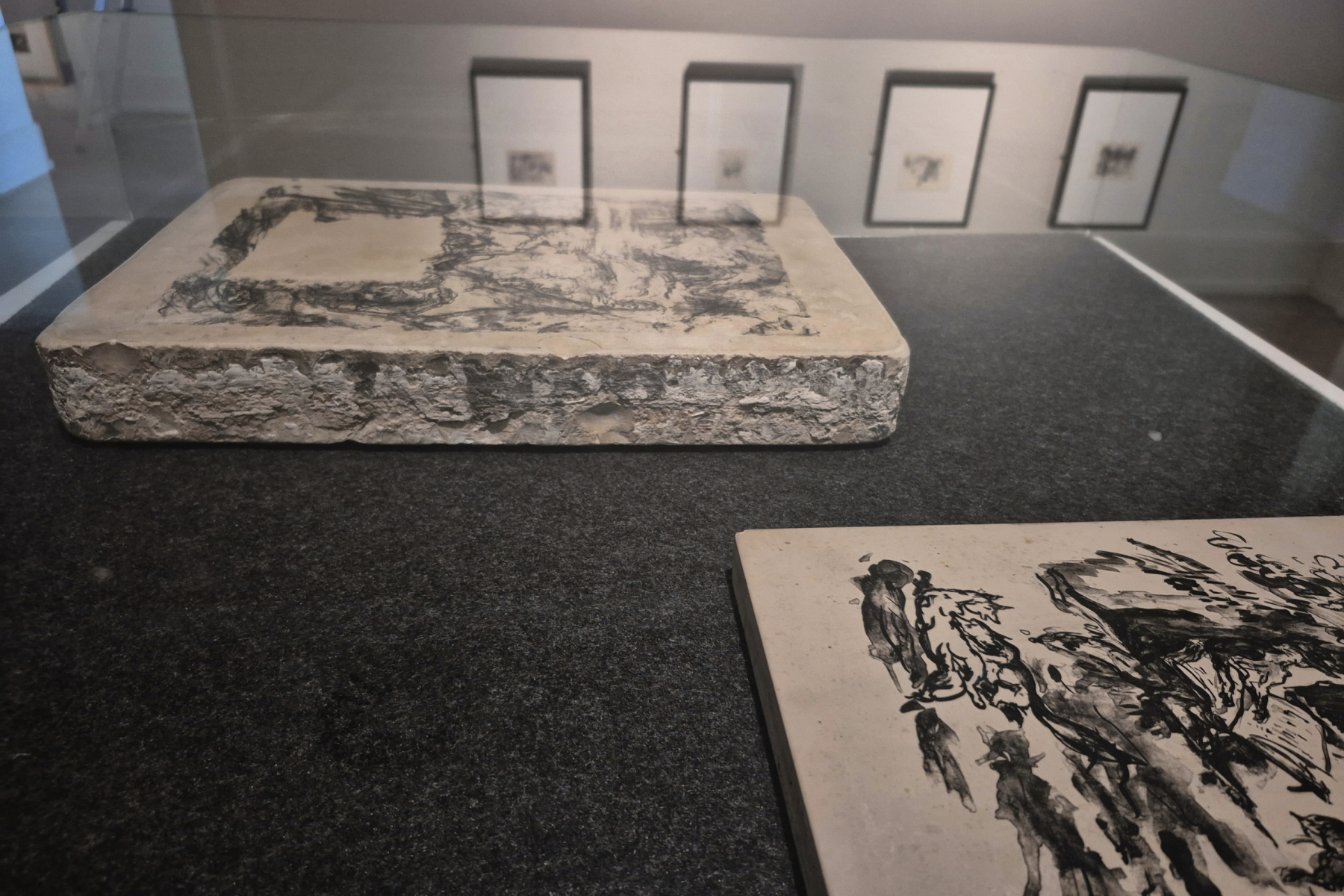
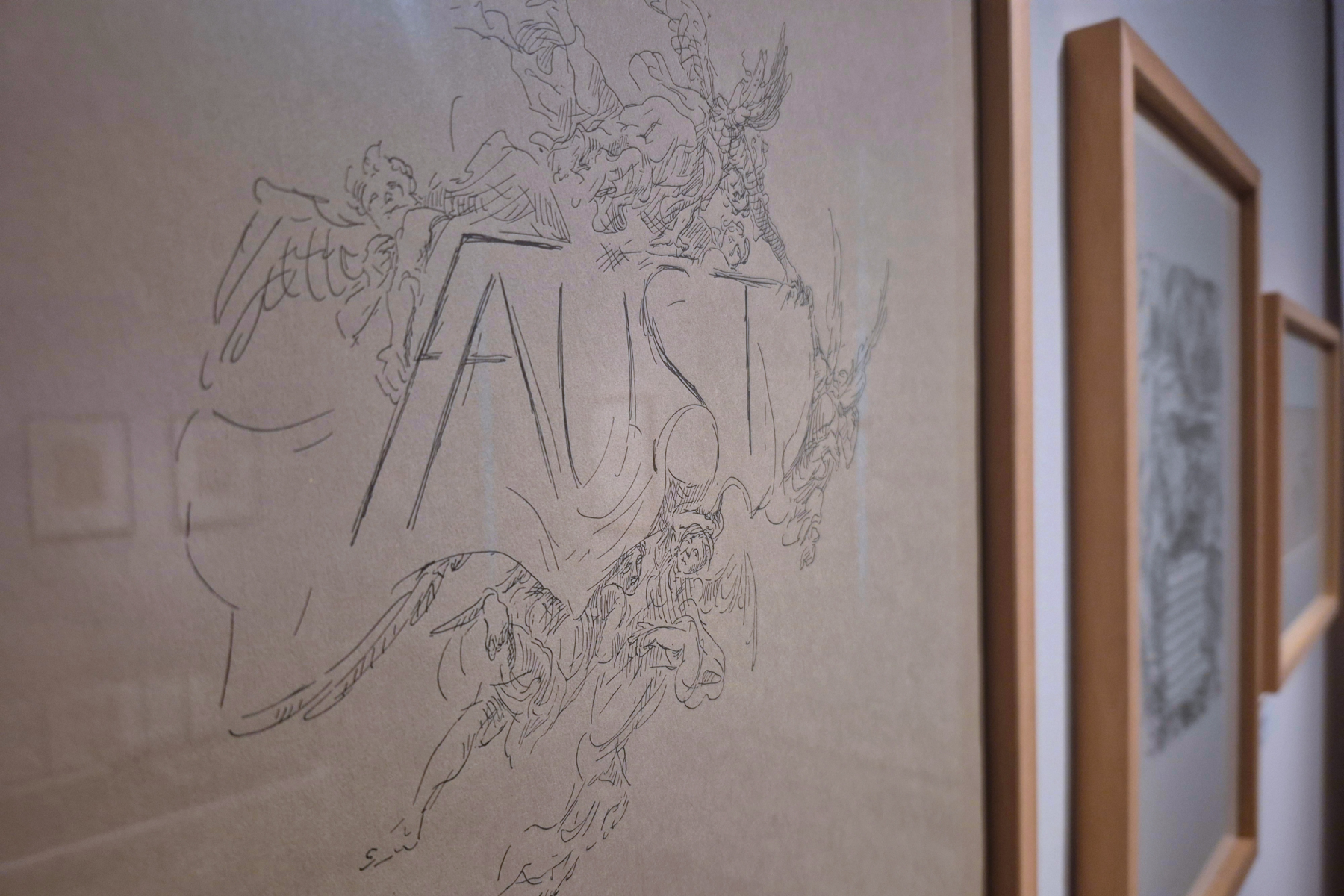
“Faust II” counts as the principal work of the congenial collaboration between Slevogt and Cassirer. With this last joint print project, the publisher took yet another financial risk. Slevogt worked on it from 1924 until the fall of 1926. Cassirer spared no effort: the drawings were printed on a hand press, and he even sent the lithographic stones to Slevogt in the Palatinate.
The 500 illustrations for Goethe’s “Faust II” count as Slevogt’s most comprehensive work in the art of the book. The portfolio edition on fine, very delicate China paper cost 3,600 reichsmarks, and even the book edition was offered at a stately 1,400 reichsmarks; in 1926 that corresponded to a slightly below-average annual income.
The lithographs and lithographic stones on display illustrate the elaborate production process. For “Faust II” Slevogt used the most varied techniques, from etching through chalk and pen lithography to marginal drawings. Templates with text fields pasted onto the lithographic stones helped him judge the size of his illustrations. With the limited edition of fifty copies, Slevogt had 21,000 sheets to sign. To keep him in good spirits during this drawn-out process, Bruno Cassirer had to come to the Romanisches Café. When “Faust II” appeared in 1927, demand was not especially great, and the disappointment all the greater. The high price was presumably one reason for this.
Slevogt’s drawings can be understood as commentaries on Goethe; in them he deliberately detached individual motifs from their original relation to time and place. This becomes especially clear in the case of Reynard the Fox. He was no likeable literary figure but unscrupulously outwitted his fellow animals. An antihero of this kind – even though he had been invented as early as 1793/94 – fitted the Weimar Republic superbly. For those years were marked by uncertainty, abuse of power, political intrigue, and mistrust, and it was this spirit of the age that Slevogt took up here.
Liebermann’s Illustrations of Goethe
Max Liebermann, too, chose his motifs according to what interested him most in terms of content. His first illustrated book edition appeared with Bruno Cassirer in 1917, devoted to the writings of Heinrich von Kleist. As with Slevogt, Johann Wolfgang von Goethe was one of his favorite authors too, so that he gladly chose Goethe’s writings as his source.
Liebermann devoted himself, among other things, to the “Novelle” (Novella, 1921) as well as to the “Mann von fünfzig Jahren” (The Man of Fifty, 1922). For these his summer house on the Wannsee and his family served as a source of inspiration. The art critic Karl Scheffler praised Liebermann’s illustrations for the fact that he managed “to give the stories a reality, and achieved [this] by […] taking his models from his own immediate surroundings.” Many an attentive viewer may recognize, in the two ladies at Flavio’s sickbed, his daughter Käthe and his wife Martha.
Even preparatory drawings have survived on the publishing house’s letterhead, showing that an idea, once conceived, demanded to be sketched at once. To this end Max Liebermann began in 1920 to draw the scenes in pen, while Martin Hönemann and Oskar Bangemann took over the transfer onto the wooden block. Liebermann’s drawings were thus published by Bruno Cassirer as wood engravings.
Hallway
Puss in Boots: Competition at Paul Cassirer
Slevogt’s oeuvre is characterized by a wealth of dynamic drawings for children’s songs, animal fables, and fairy tales. The fairy tales of the Brothers Grimm inspired him as well. On the basis of the illustrations that resulted, Bruno Cassirer created a series of his own, in larger editions and at moderate prices. The art critic, writer, and long-standing editor-in-chief of the monthly “Kunst und Künstler” (Art and Artists), Karl Scheffler, noted of the finished works: “Slevogt agreed with the selection, but he kept asking for fairy tales in which the devil appears. He also liked to draw animals, and would then sit at the café table pondering the question of what outwardly distinguishes a fox from a wolf.”
The cat is said to have been one of Slevogt’s favorite animals, which becomes clear in the affectionate execution of these sheets. For his fairy-tale illustrations he chose the pen, since the printing process for such drawings proved far less elaborate than that for lithographs.
The publication project “Der Gestiefelte Kater” (Puss in Boots) by the Brothers Grimm stood under the sign of the rivalry that prevailed between the Cassirer cousins. This fable had appeared with Paul and not with Bruno Cassirer. In September 1901, the cousins had resolved on a business separation and agreed to observe a moratorium until 1908, in order to avoid direct competition between the two firms: from then on Paul Cassirer was to work as an art dealer and Bruno Cassirer as a publisher. In 1908 the term finally expired, and so Paul Cassirer returned to publishing as well. Bruno Cassirer, in turn, tried his hand as an art dealer.